Navigating the Age of Agents: Why I'm Building Wayfinder
As AI agents transform work at breathtaking speed, we need new navigational tools. This is why I'm building Wayfinder—a modern compass for the age of intelligent augmentation.
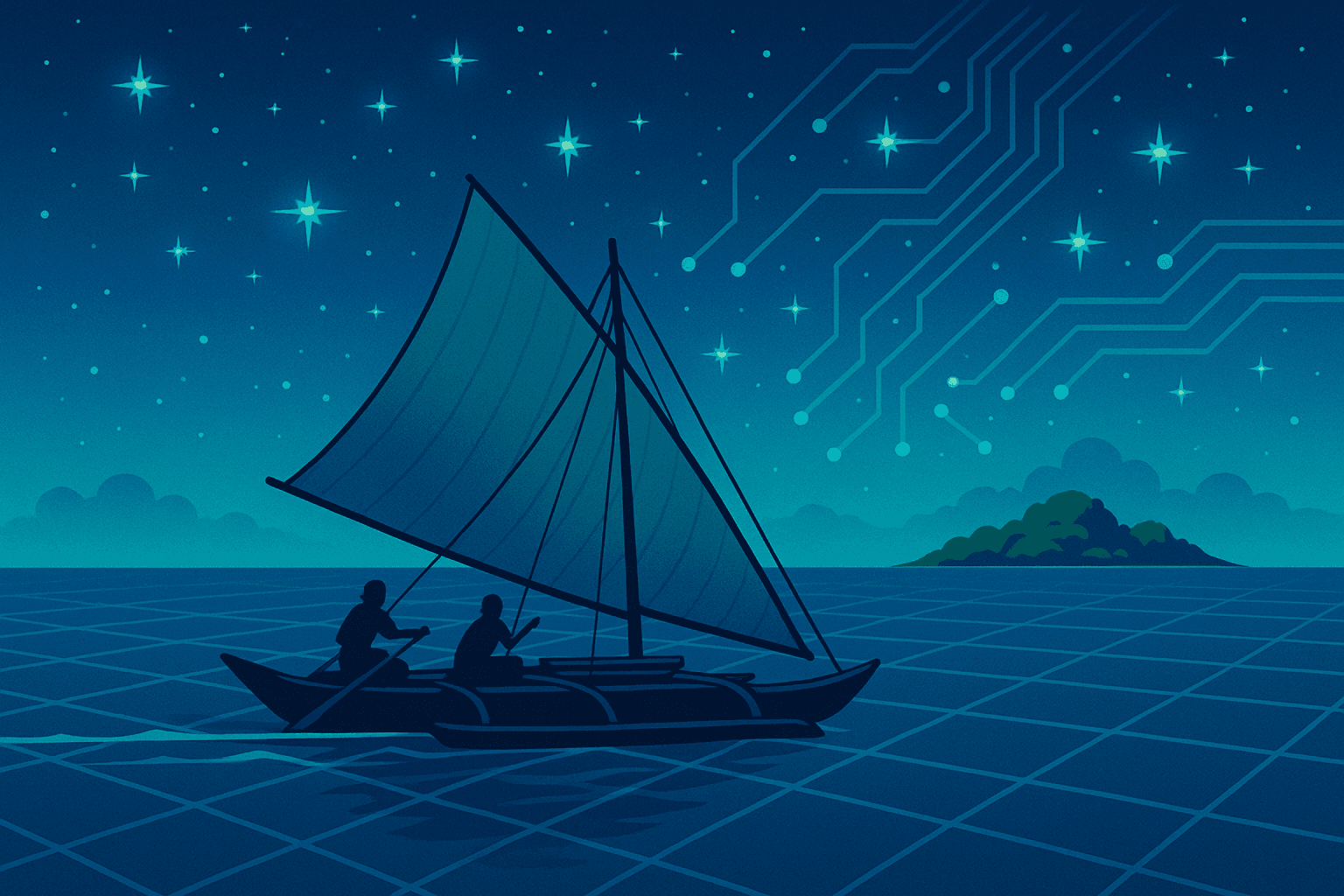
“A Wayfinder is the navigator at the centre of a circle of sea and sky, reading nature’s signs to hold a course across vast Pacific distances.”
- Astronomer and voyaging Historian Will Kyselka, Hawaiian Sky
In the 15th century, Portuguese explorers ventured beyond the safety of coastal navigation into the uncharted Atlantic. Their success hinged not on courage alone, but on a revolution in wayfinding tools: the magnetic compass, the astrolabe, and the portolan chart. Without these innovations, the Age of Discovery would have been impossible; with them, humans charted paths through previously impenetrable unknowns.
We stand at a similar inflection point today. The explosive emergence of AI agents is fundamentally altering our relationship with work, expertise, and professional identity. But unlike the Portuguese, we haven't yet developed our modern equivalents of the astrolabe and portolan chart—the orientation systems needed to navigate this new territory with confidence and purpose.
That's why I'm building Wayfinder.
The Vertigo of Professional Displacement
My journey to starting this blog began with a sense of vertigo. Having spent years straddling the worlds of tech startups and human capital development, I watched as traditional methods for evaluating professional capabilities began to falter in the face of AI augmentation.
In recruitment conversations, I noticed a peculiar phenomenon: candidates would claim proficiency with AI tools, but when asked to demonstrate those capabilities, a startling gap emerged between claims and actual performance. Some overclaimed dramatically. Others genuinely believed they were skilled but had no framework for understanding their true level of capability. And most fascinating were those who dramatically underclaimed - people doing extraordinary work with AI augmentation but lacking the language to articulate their approaches.
By 2028, Gartner predicts 33% of enterprise software applications will incorporate agentic AI, up from less than 1% in 2024, with 15% of day-to-day business decisions becoming fully autonomous. (Gartner) Meanwhile, 57% of workers are already inclined to use AI agents, with 58% actively integrating them into workflows. (PEGA) The transformation is happening at breathtaking speed, yet our systems for verifying capabilities remain anchored in a rapidly receding era.
This isn't merely an inconvenience. It's a fundamental crisis of professional orientation. When the Portuguese ventured into the open ocean, they experienced a literal loss of landmarks. The coastal features that had guided navigation for centuries suddenly disappeared. Today's knowledge workers face an analogous loss as traditional markers of expertise begin to dissolve.
"The most profound technologies are those that disappear. They weave themselves into the fabric of everyday life until they are indistinguishable from it." — Mark Weiser
AI agents have begun this disappearing act, becoming ambient collaborators that reshape how we think, create, and evaluate. This disappearance makes them simultaneously powerful and disorienting—we struggle to distinguish between human expertise, technological augmentation, and the magical interstitial spaces where true innovation happens.
Historical Echoes: When Information Exploded
We've been here before, though never at this pace or scale.
By 1500, just 60 years after Gutenberg's innovation, Western European printing presses had produced more than 20 million volumes. This information explosion "permanently altered the structure of society" as "relatively unrestricted circulation of information and ideas transcended borders" and "threatened the power of political and religious authorities." (The Coming of the Book: The Impact of Printing 1450–1800, p.186)
What's fascinating isn't just the social disruption, but the navigational innovations that emerged in response. The printing process created standardised formats: the same stuff in the same place. So it meant page numbering, tables of contents, and indices became common. These seemingly mundane innovations were critical wayfinding tools that transformed how humans navigated knowledge, enabling source attribution and the ability to quickly and easily reference and build on another piece of work or idea.
When information landscapes transform, humans develop new navigational methods. The question is whether we develop them quickly enough to prevent prolonged disorientation.
The Crisis of Capability Verification
The current system for evaluating professional capability rests on three shaky pillars: credentials that signal past learning, portfolios that document past work, and interviews that assess articulation rather than performance. All three are collapsing under the weight of AI augmentation.
Credentials struggle to keep pace with rapidly evolving skill requirements. The World Economic Forum, where my co-founder is a fellow, predicts the shifting division of labor between humans and AI will disrupt nearly one quarter of ALL of today's jobs (22%). ([WEF] (https://reports.weforum.org/docs/WEF_Future_of_Jobs_Report_2025.pdf)) According to research by my alum, 64% of employees expect AI to impact their roles, ranging from requiring new skills, to task adjustments or significant reskilling. (Accenture) Traditional educational institutions simply cannot iterate quickly enough.
Portfolios become increasingly ambiguous about the division of labour between people and machines. When reviewing a marketing strategy, product design, or code repository, how do we distinguish between human insight and AI contribution? More importantly, why would we even try to separate them when the most valuable capability is often the artful orchestration of both?
And interviews? They've always favoured articulation over demonstration. The ability to describe expertise rather than demonstrate it. This gap widens dramatically with AI capabilities that are often intuitive, emergent, and resistant to verbal explanation. I've watched brilliant AI collaborators struggle to explain their approaches in person while less capable candidates craft compelling narratives about capabilities they don't possess… I'm willing to bet we all have.
(The fact start-ups like 'Cluely' are now helping people cheat in interviews just emphasises this)
The Polynesian Navigators: A Template for the Future
When seeking models for our current moment, I find myself drawn not to Silicon Valley but to the Polynesian Wayfinders who traversed thousands of ocean miles using sophisticated observational techniques. These navigators didn't divide the world into natural and technological… they created integrated knowledge systems that combined environmental reading, celestial observation, and cultural transmission. (The Polynesians: Prehistory of an Island People, p.42)
The Wayfinder wasn't valued merely for knowing facts but for synthesising multiple knowledge streams into actionable guidance. They didn't memorise routes; they understood patterns. They didn't follow maps; they read the ocean itself.
This tradition suggests a profound shift in how we might understand expertise in the age of agents—moving from static knowledge to dynamic synthesis, from memorisation to pattern recognition, from following procedures to reading environments.
MIT economist David Autor, once known for documenting technology's erosion of middle-class jobs, has reconsidered his position with AI. He now argues that "AI, if used well, can assist with restoring the middle-skill, middle-class heart of the U.S. labor market that has been hollowed out by automation and globalisation." (NY Times)
The critical distinction is that modern AI can "change the economics of high-stakes decision-making so more people can take on some of the work that is now the province of elite, and expensive, experts." Evidence supporting this democratisation appears in studies of AI assistance in customer service contexts, where "low-skill agents begin communicating more like high-skill agents" when supported by AI tools, essentially flattening traditional skill hierarchies. (National Bureau of Economic Research, USA)
This is not expertise replacement but expertise transformation much as the compass didn't eliminate the navigator but transformed how navigation happened.
From Gatekeeping to Wayfinding
Today's credentialing and assessment systems are fundamentally gatekeeping mechanisms. They're binary judgments about who belongs inside or outside a professional domain. This made sense in a world where expertise was scarce, stable, and clearly defined.
But what if we're entering an era where expertise is abundant, constantly evolving, and increasingly collaborative? This requires shifting from gatekeeping to Wayfinding, from binary judgments to continuous orientation.
Research on cognitive load in human-AI collaboration suggests we're entering an era where we can offload a wide range of cognitive tasks to AI assistants, changing how we attune for cognitive load management. ([PubMed, 2023] (https://pmc.ncbi.nlm.nih.gov/articles/PMC10466077/)) Good. we are having to handle more information than ever and we, as a collective workforce, are more burnt out than ever. A global survey by DHR Global, published earlier this year, found that 82% of white-collar workers worldwide are experiencing burnout, despite high engagement levels. (SIA) I know as I've personally felt this.
The most productive approach appears to be what researchers describe as "durable learning" through AI collaboration, where "workers see productivity gains relative to their pre-AI baseline even when recommendations are unavailable," with these gains "more pronounced for workers who had more prior exposure to AI assistance." (NBER)
AI systems function not just as tools but as sophisticated pedagogical partners that enhance human capabilities over time. This doesn't fit neatly into traditional assessment paradigms that assume skills are acquired first and then deployed.
The Wayfinder Approach: Building a Modern Compass
This brings us to the start-up I'm building with my co-founder, Ascend: our attempt to build a modern compass for work in the age of agents.
The fundamental principle is simple: demonstration over declaration. At Ascend, we measure what people can actually accomplish with AI augmentation, not what they claim to know about AI. This requires shifting from static credentials to dynamic verification, from standardised tests to adaptive challenges, from theoretical knowledge to practical synthesis.
Our assessment approach draws from cognitive science research suggesting that just as physical Wayfinding involves three key elements: "spatial coding, landmark anchoring, and route planning".. these same mechanisms can be applied to abstract domains. For AI navigation, this translates to:
- Spatial coding: Developing mental models of AI capabilities and limitations
- Landmark anchoring: Identifying stable reference points in shifting technological landscapes 3.** Route planning: **Creating strategic approaches to human-AI collaboration that optimise complementary strengths
The goal isn't to certify people as "AI experts" (a fundamentally unstable category) but to provide continuous orientation in rapidly evolving capability landscapes. We don't want to be gatekeepers; we want to be mapmakers for a territory that keeps changing shape.
The Philosophical Stakes: Agency in an Automated Age
Beyond the practical challenges, there's something deeper at stake: human agency itself.
As Foucault's framework of "technologies of the self" evolves into broader "identity technologies" in the digital age, we see that "profilicity," identity construction through digital profiles and data, is "closely related to the development of new digital technologies." Some philosophers consider this shift potentially perilous, corresponding to what "Heidegger refers to as Seinsvergessenheit (the 'forgetting of Being')." (From Technologies of the Self to Identity Technologies, 2023)
The fundamental question becomes not just how to use AI agents effectively, but how to maintain authentic human agency when increasingly sophisticated tools perform traditional knowledge work. I believe the answer lies in developing a deeper understanding of what makes human insight distinctive: our capacity for spatial and abstract thinking, ethical judgment, embodied cognition, our culturally situated reasoning that enables us to overcome the messiest of messy scenarios. However, most importantly I believe what will continue to set us apart is our taste, our curiosity, and our pioneering goal-driven nature that compels us to ask: What's beyond the horizon?
Wayfinder isn't just about measuring skills; it's about preserving meaningful human agency in increasingly automated environments. Not through resistance to automation, but through a more sophisticated integration that amplifies distinctly human capabilities.
A Vision of Integration: Neither Human Nor Machine, But Both
The future I'm working toward isn't one where humans compete against machines, nor one where humans are rendered obsolete. It's a future where the boundary between human and technological capability becomes fluid and complementary where we stop asking "is this human or machine intelligence?" and start asking "what new forms of intelligence emerge through this collaboration?"
But beyond efficiency gains is the potential for a fundamental restructuring of expertise itself. When we stop treating AI as either a threat to replace us or a tool we control completely, we open space for a more profound integration,… one where capacity for wise collaboration becomes more valuable than siloed technical knowledge.
The Calling of Our Moment
The Portuguese explorers didn't set sail because navigation became easier; they sailed because new navigational tools made previously impossible journeys conceivable. The printing press didn't simply make existing information more accessible; it created entirely new information ecosystems that transformed how humans thought.
We stand at a similar threshold. The question isn't whether AI agents will change work, they already are, but whether we'll develop the navigational tools needed to traverse this new territory with confidence and purpose.
That's the promise of Wayfinder: not merely to certify what people already know, but to orient them within rapidly evolving capability landscapes; not to gatekeep professional domains, but to illuminate paths through them; not to resist technological augmentation, but to reveal its most profound human potentials.
In the words of the ancient Wayfinders: "We sail not because the journey is necessary, but because we have learned to read the stars." How will you navigate when the stars themselves are changing?
If you're curious about the future of work in the age of AI agents and how we're building navigation systems for this new era, subscribe to The Wayfinder Notes or share your perspective in the replies.